

The idea worth taking
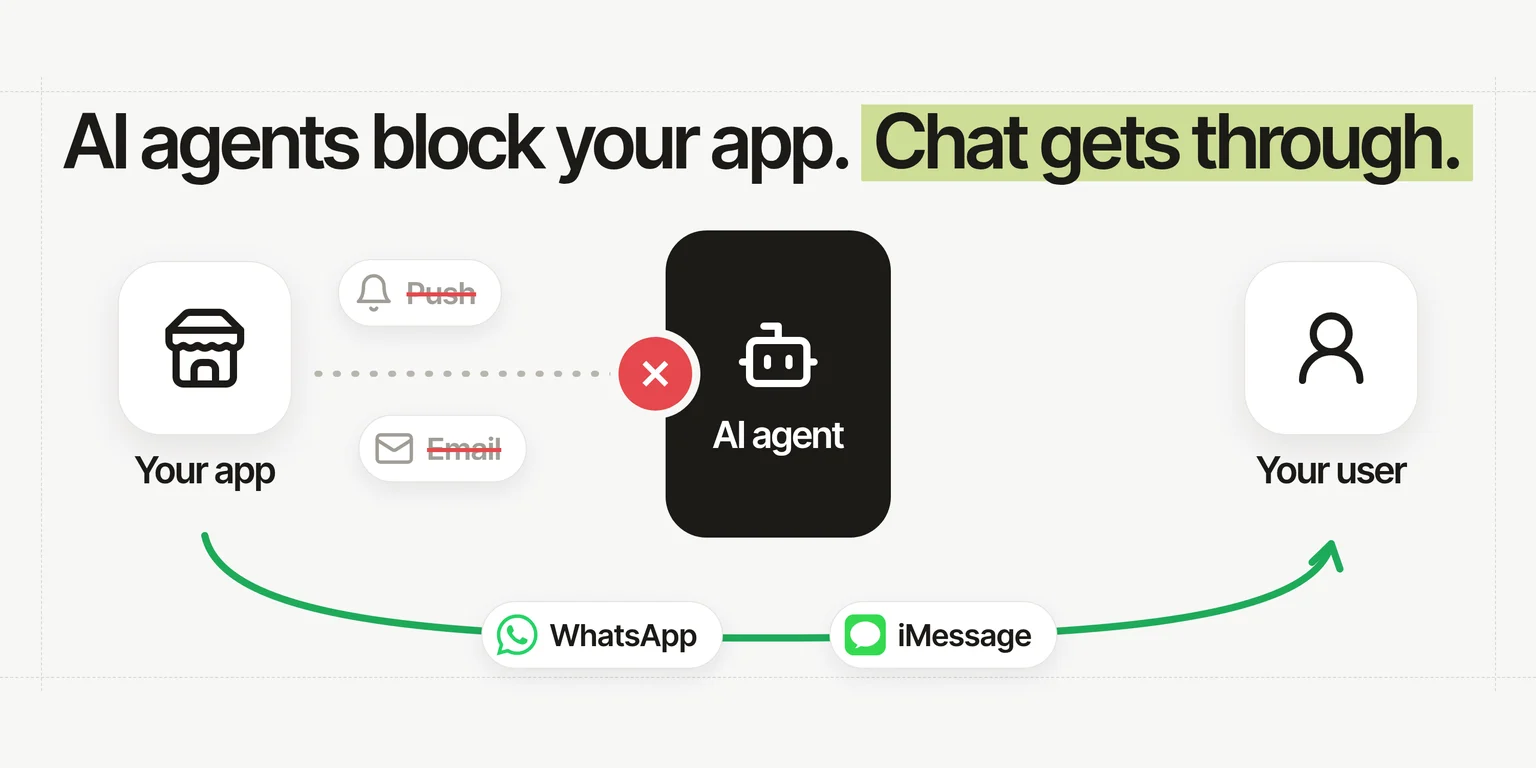
When Instinct or Muse orders from your app, the agent keeps the customer relationship and filters what you send. Be available to Instinct, Muse, ChatGPT and Claude so you win the order, and open a direct WhatsApp or iMessage chat with every customer so you can still reach them afterwards.
Personal agents are the hottest product category right now. Instinct is growing incredibly fast, Meta shipped Muse, and every big AI company is fighting to own the entry point to your user’s life.
I’ve been reading every Instinct interview, podcast and teardown I could find. There’s one thing almost nobody building a consumer app is talking about:
If your user’s time gets routed through Instinct or Muse, you lose the user.
Not some of the user. All of them.
This is going to be a bit long!
What Instinct is actually building
Instinct’s founder, Noah Shinn, has a one-line pitch: there are no new interfaces.
You don’t download anything. You text Instinct on iMessage or WhatsApp, or you call it. It books your travel, buys your stuff, manages your to-dos and remembers everything about you.
Some numbers from his interview on Invest Like the Best:
- Instinct is growing about 10% a day
- it handles roughly $1 billion a year in transactions
- about half of that is travel
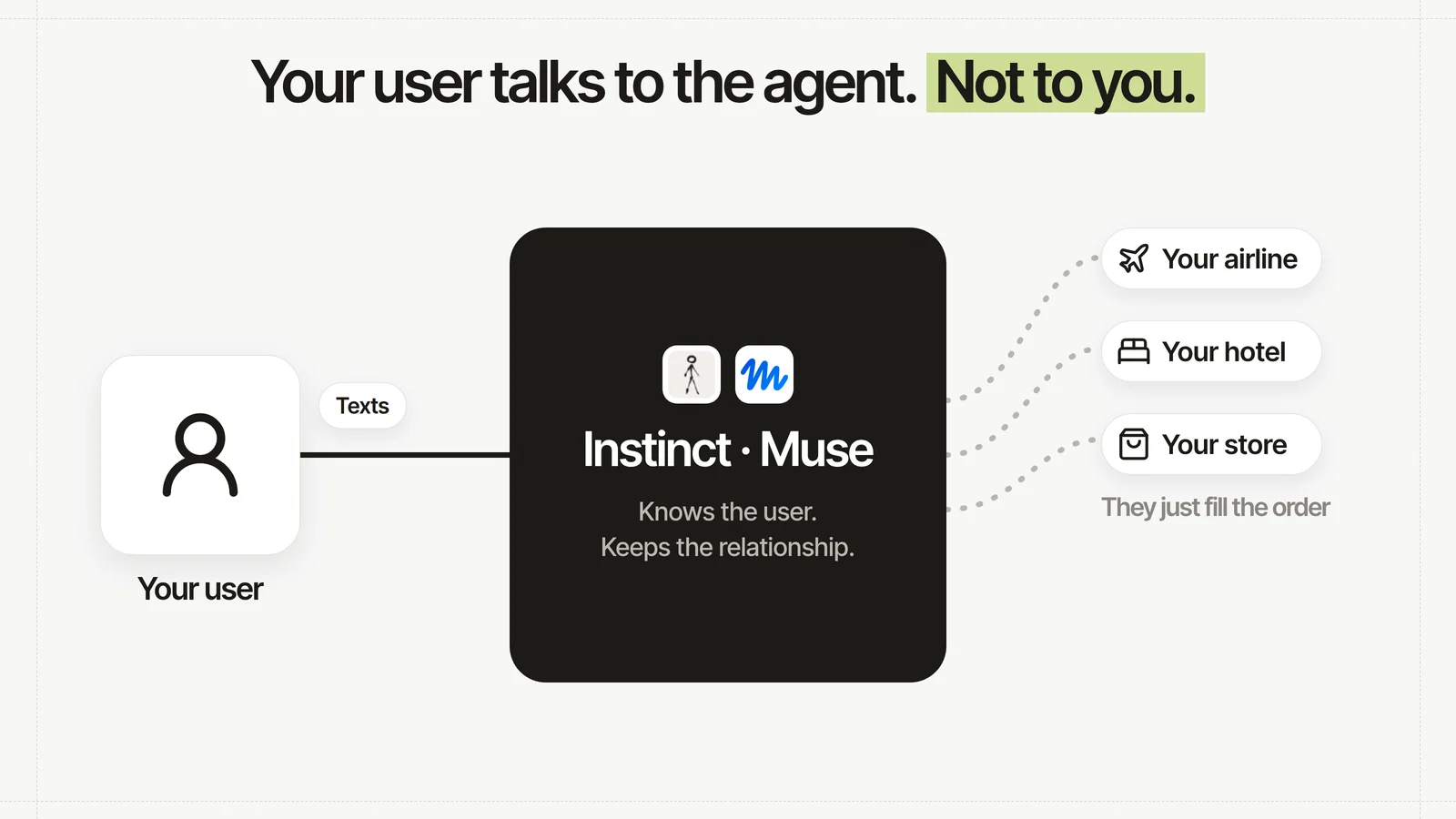
Read that last one again. Around half a billion dollars of travel bookings where the airline, the hotel and the booking site never talk to the customer. Instinct talks to the customer. The business just fills the order.
Muse and everyone else
It isn’t only Instinct. Meta launched Muse on 8 September 2026 with access to WhatsApp, payments, email and shopping. ChatGPT and Claude are moving the same way. Every one of them wants to sit between your user and the internet.
The personal agent protocol
Here’s the model all of these agents are converging on:
Your user
    │
    │  "Book me a flight to Goa, same as last time."
    ↓
Personal agent (Instinct, Muse, ChatGPT, Claude)
    │
    ├── memory and a profile of the user
    ├── preferences ("hates layovers", "window seat")
    ├── a filter on everything coming in
    │
    ↓
Your app, API or website
    │
    └→ Order placed. And that's the last you'll hear from them.
The agent is the user’s interface now. Your app is a backend.
That’s fine for the transaction. It’s terrible for everything that comes after it.
There is even a standard forming around this. The Personal Agent Protocol (Poppy) defines how agents sign in to companies and act for people. Its current draft still lists push notifications as an open topic. Nobody has agreed yet on how a company reaches a person through their agent.
The filter goes both ways
Here’s the part people miss.
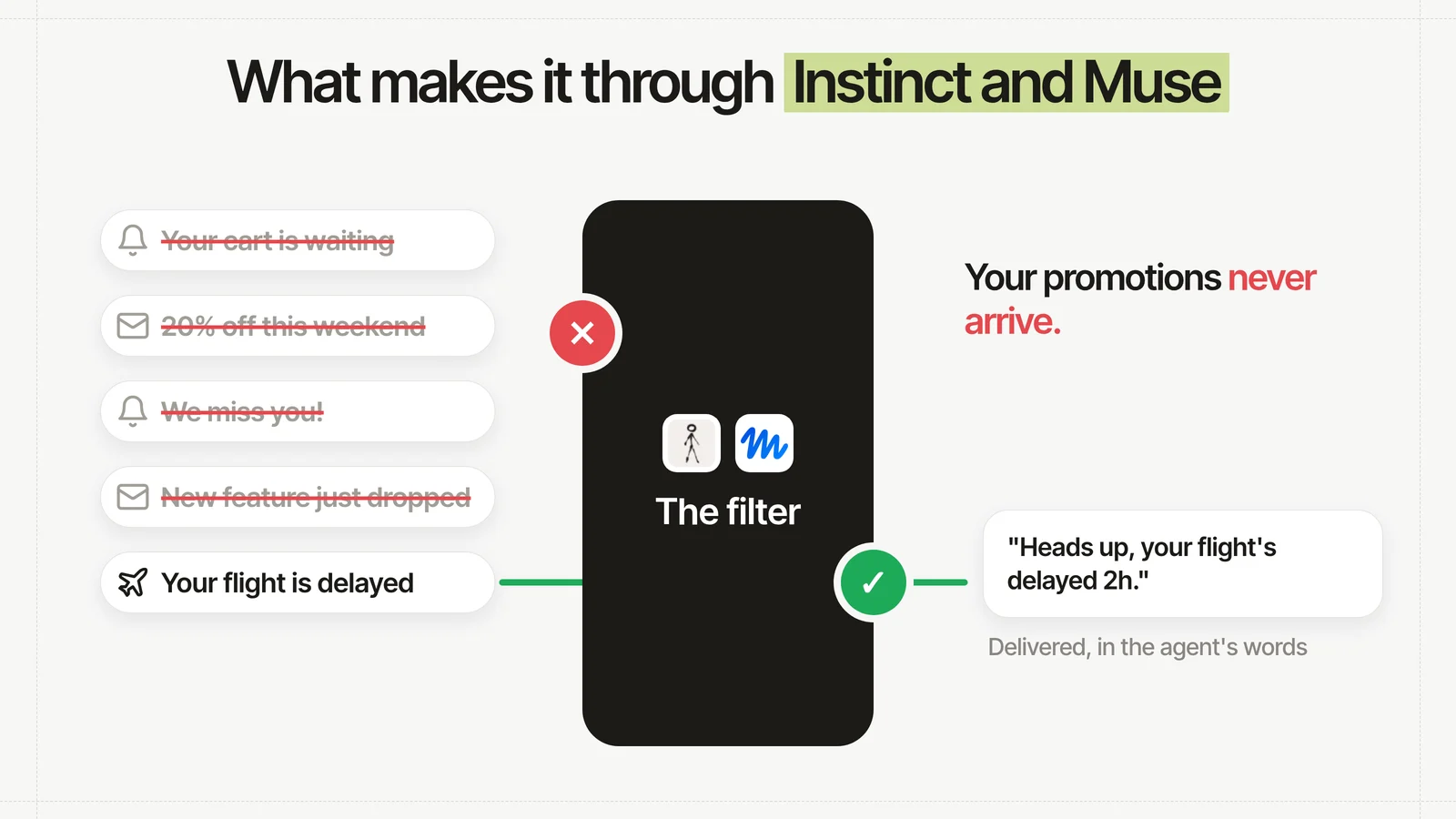
Instinct and Muse are useful because they filter. Their whole job is to protect the user’s attention. Instinct is proactive precisely because it decides what’s worth interrupting you for. It will call you when something is urgent, and only then.
So ask yourself: when your app sends
- “Your cart is waiting”
- “20% off, this weekend only”
- “We miss you!”
- “New feature just dropped”
does that make it through a filter whose job is to protect the user from exactly that?
No. Not because these companies are evil. Their product gets better every time they block you. An agent that forwards your promo push is a worse agent.
My read of where this goes (this is my take, not something either company has said):
| What you send | What happens |
|---|---|
| Order updates (“your flight is delayed”) | Gets through, summarised in the agent’s voice |
| Marketing and re-engagement | Filtered |
| Your brand voice | Gone, rewritten by the agent |
| Push notifications | The user never opens your app, so there’s nothing to push to |
| Your relationship with the user | Owned by the agent |
The agent becomes the CRM. You become a supplier.
Email is not the answer
“We’ll just email them.” No, you won’t.
Most marketing email already goes unread. Now put a personal agent in front of the inbox. The agent reads your email, decides it isn’t important, and the user never sees it. Personalisation is the filter.
In the age of personal agents, email is a write-only channel.
Where users are still reachable: chat
One thing in all of this hasn’t changed, and it’s the very thing Instinct is betting on:
People live in chat.
Instinct didn’t build an app. It built on iMessage and WhatsApp, because that’s where people actually read things. Muse ships on WhatsApp for the same reason.
The interface everyone is converging on is a chat thread, and a chat thread with a real business is still a direct line. Your message on WhatsApp or iMessage lands in the same place as a message from a friend. No agent rewrites it on the way in.
So the playbook for a consumer app in 2026 is both:
          ┌──────────────────────────────┐
          │    Be available to agents    │  ← Instinct, Muse, ChatGPT, Claude
          │  (or lose the transaction)   │
          └──────────────┬───────────────┘
                         │
                    transaction
                         │
          ┌──────────────↓───────────────┐
          │  Own a direct chat channel   │  ← WhatsApp, iMessage
          │      (or lose the user)      │
          └──────────────────────────────┘
Skip the first and you don’t get the order. Skip the second and you get one order and never hear from that customer again.
How we are solving this at Flow
This is exactly what we’re building at Flow.
1. Make your product work with agents. Your product works with Instinct, Muse, ChatGPT and Claude, so when a user’s agent tries to buy from you, it can. You don’t lose the sale to a competitor who was easier for the agent to use. If you’re starting from zero, read what companies should do about Poppy this week.
2. Open a direct channel on every agent order. Whenever someone buys from you through an agent, Flow starts a conversation with that person on WhatsApp or iMessage, from your business. On WhatsApp that’s an approved template. On iMessage it’s an opt-in link the customer taps once.
That means you now have:
- a direct, one-to-one chat with the human, not their agent
- a channel that no agent’s filter sits in front of
- a way to reach them when it actually matters
3. Give them a reason to come direct. Once the chat is open, you can reward customers for using your product directly in your chat instead of through Instinct or Muse: better prices, loyalty perks, faster support, early access, whatever fits.
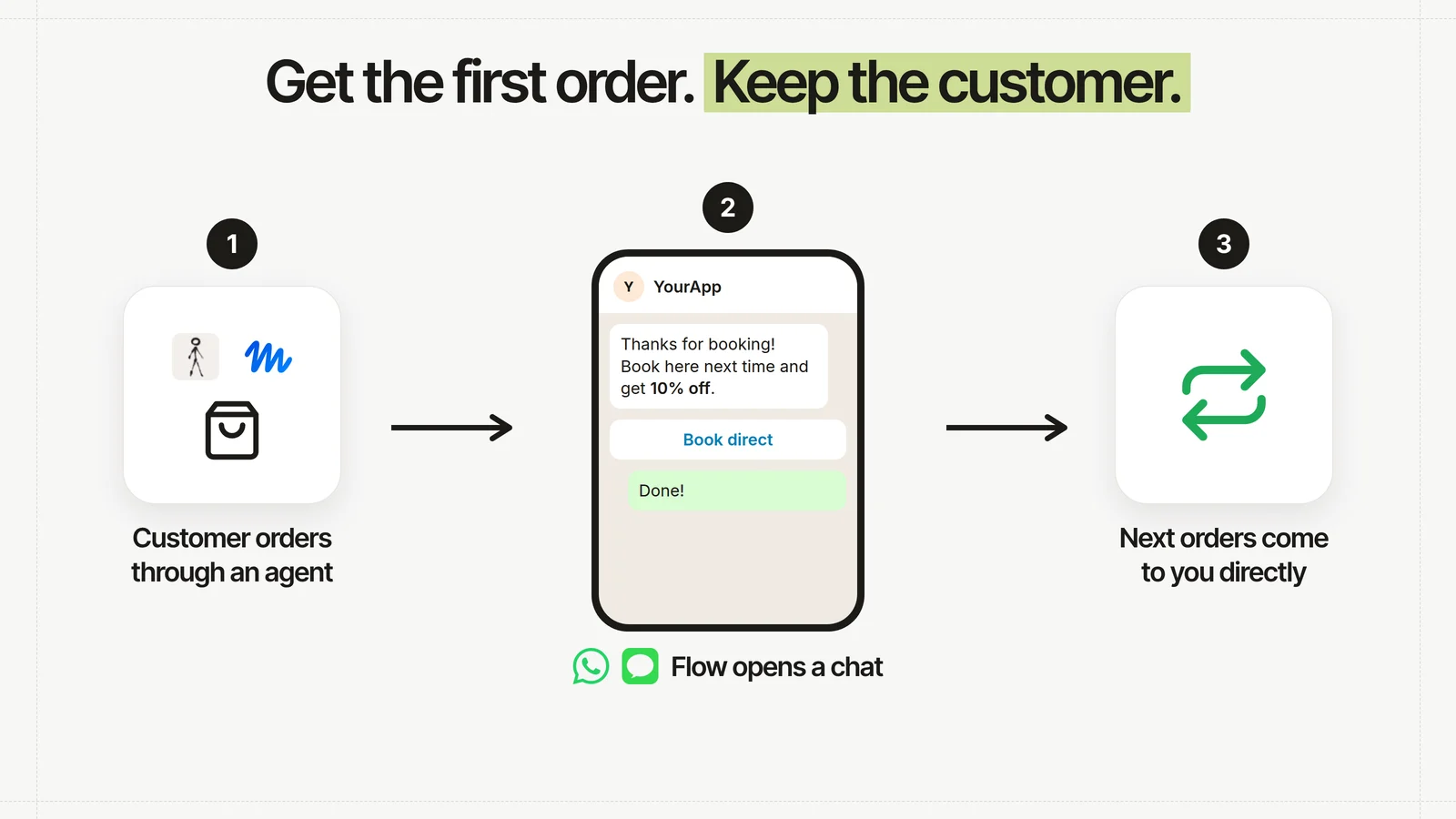
The agent brought you the first order. You keep the customer.
The short version
- Instinct, Muse and other personal agents are becoming the main interface for consumers. Be available on them.
- Their whole value is filtering, and your notifications are what gets filtered.
- Email disappears behind personalisation.
- Chat (WhatsApp and iMessage) is the one place you can still reach a person directly.
- Be on the agents and own a direct chat with every user they send you.
That’s what we’re building at Flow. If you run a consumer app and Instinct traffic is starting to show up in your numbers, message me on LinkedIn. I’d love to show you.